January 2026
New lab preprint
04/01/26 21:46 Category: Papers
🌟 New lab preprint on bioRxiv 🐸🧬
“Non-canonical sex chromosome evolution revealed by extreme heterogeneity in homomorphic Y chromosome differentiation in the common frog”
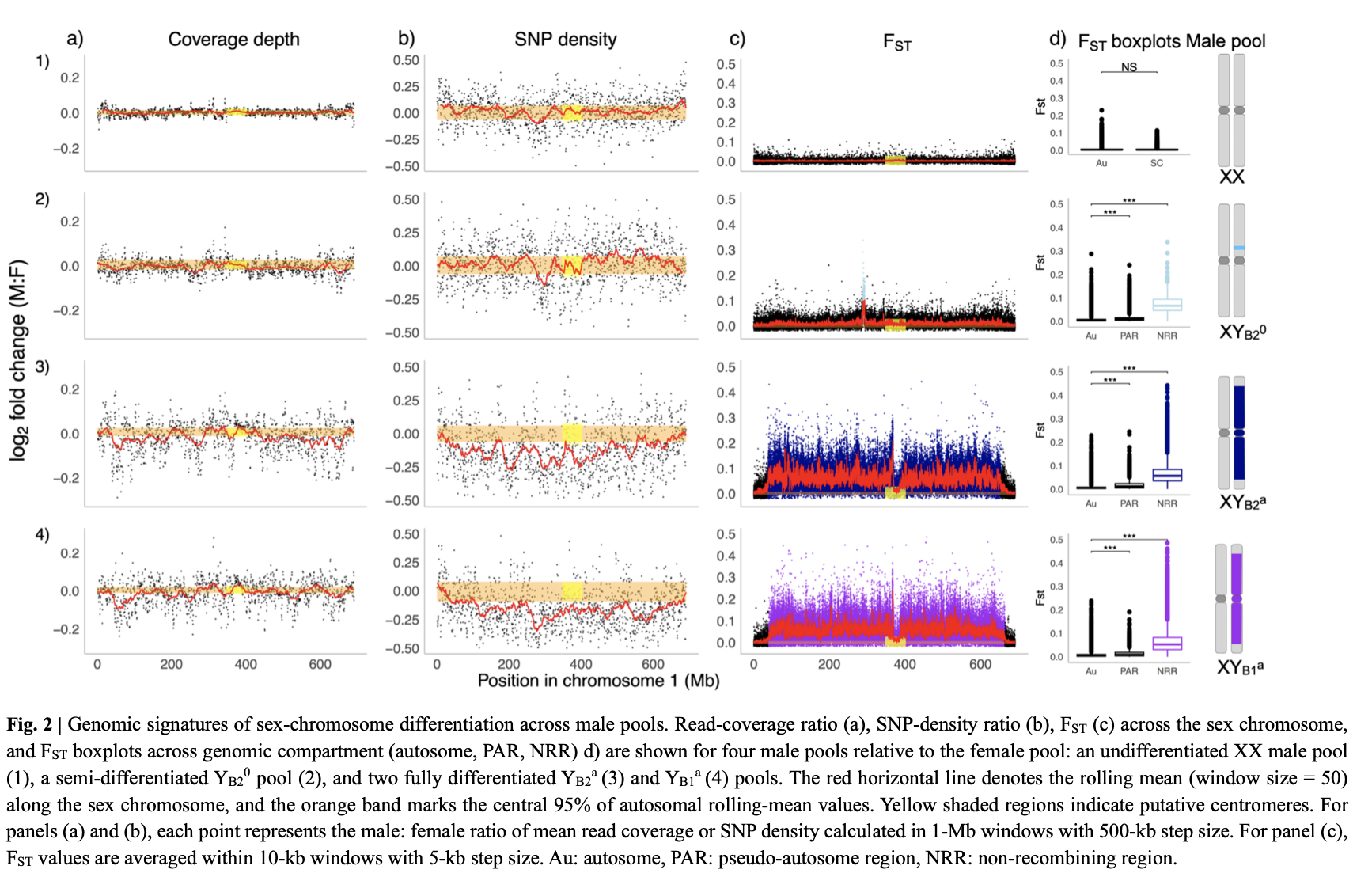
This project has been many years in the making and reflects a true team effort across several labs. It hasn’t been an easy journey, but I’m very grateful to finally share the work. In this study, we show that sex chromosome evolution does not always follow the classical, irreversible path of stepwise recombination suppression and Y degeneration. Instead, using population genomics, androgenesis, and transcriptomics in the European common frog, we uncover striking heterogeneity in Ychromosome differentiation among coexisting male genotypes in a single Swiss pond, ranging from undifferentiated to nearly fully non-recombining along the sex chromosome, yet with minimal Y-linked gene decay. Together, our findings reveal a non-canonical pathway of sex chromosome evolution, shaped by sex-specific recombination landscapes and sex reversal, challenging the universality of classical models and highlighting the value of nonmodel vertebrates for understanding sexchromosome diversity.
Huge thanks to all collaborators involved 🙏💪, and to frogs 🐸 , of course.
https://www.biorxiv.org/content/10.64898/2025.12.31.697208v1
“Non-canonical sex chromosome evolution revealed by extreme heterogeneity in homomorphic Y chromosome differentiation in the common frog”
This project has been many years in the making and reflects a true team effort across several labs. It hasn’t been an easy journey, but I’m very grateful to finally share the work. In this study, we show that sex chromosome evolution does not always follow the classical, irreversible path of stepwise recombination suppression and Y degeneration. Instead, using population genomics, androgenesis, and transcriptomics in the European common frog, we uncover striking heterogeneity in Ychromosome differentiation among coexisting male genotypes in a single Swiss pond, ranging from undifferentiated to nearly fully non-recombining along the sex chromosome, yet with minimal Y-linked gene decay. Together, our findings reveal a non-canonical pathway of sex chromosome evolution, shaped by sex-specific recombination landscapes and sex reversal, challenging the universality of classical models and highlighting the value of nonmodel vertebrates for understanding sexchromosome diversity.
Huge thanks to all collaborators involved 🙏💪, and to frogs 🐸 , of course.
https://www.biorxiv.org/content/10.64898/2025.12.31.697208v1